
Annual event being organised by FICCI focuses on the investment potential offered by India's infrastructure sector.

The question is no longer whether the war will expand. It has. The next few days will tell us whether the war stabilises around Hormuz or whether the Strait itself becomes the trigger for a far larger rupture. What to watch for over the next 48 hours is simple: Any move by the US toward direct naval control of the Strait; any credible Iranian attempt to disrupt or mine shipping lanes and, critically, whether energy infrastructure in the Gulf continues to be targeted.If those lines are crossed in tandem, the war will no longer be containable within the region.

Iran is fighting a different war: Older, slower, and in some ways more dangerous. Iran doesn't need to shoot down an F/A-18. It only needs to make the Strait of Hormuz feel dangerous long enough for insurance markets, shipping companies, and oil futures traders to do the rest. Prem Panicker continues his must-read daily blog on the war in the Middle East.

Israel and the United States had a plan. Iran punched back. And now the Gulf is reeling, the world is beginning to feel the pain and, as on date, no one in Washington or Tel Aviv appears willing to admit that the punch has landed, notes Prem Panicker, continuing his must-read blog on the war in the Middle East.

Addressing the Chicago Council on Global Affairs in Chicago, Singapore PM Lee Hsien Loong said economies across the globe are rebounding and the world is no longer staring into an 'abyss'.

The Global Cities Index measures global engagement of cities across five dimensions: business activity, human capital, information exchange, cultural experience, and political engagement.
She says out of every Rs 100 meant for infrastructure development, only Rs 16 is used.
Marshall Bouton, South Asia expert, says that the fallout from a failed nuclear deal could jeopardise India-US ties

'And if the United States, at that time, perceives India to have welched on the deal, not been our friend, when we did so much to make it a friend, that's trouble.'
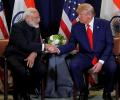
'I give Modi full credit, for brilliantly using his personal diplomacy, his personal stature, to accomplish his goals...'

'Although perhaps not with a greater majority, and maybe even a slightly reduced majority in the Lok Sabha.'

"It's ironic that Modi visited Tokyo a few days ago and talked about China's expansionism. The key now will be to get beyond such unnecessary controversies and start afresh.'
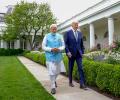
'India will want a lot of help from the US, but it's not going to want US troops.'
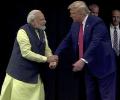
'... to Imran Khan, that there's not going to be any mediation of any meaningful sort given his (Modi's) special relationship with Trump.'

'This is a historic juncture when the US is in great need of an alliance with India to strengthen its hands in the fierce struggle with China in the Asian theatre,' points out Ambassador M K Bhadrakumar.

North Korea is unlikely to strike first, but its response in retaliation, if attacked, could be massive even at the expense of its own destruction, says Rajaram Panda.

'In the past the US has been reluctant to name Pakistan directly in an US-India joint statement.'

'The real test will be in defence-related deals, for instance the Javelin anti-tank missile: Is the US willing to co-develop something with India, on terms that will support the 'Make in India' initiative? Is there defence technology transfer? Or will it dump old junk on India?' asks Rajeev Srinivasan.
